MERAL ZAHID

PRIMARY RESEARCH


History of Music Videos
.png)
Types of MV


.png)
.png)
SECONDARY RESEARCH
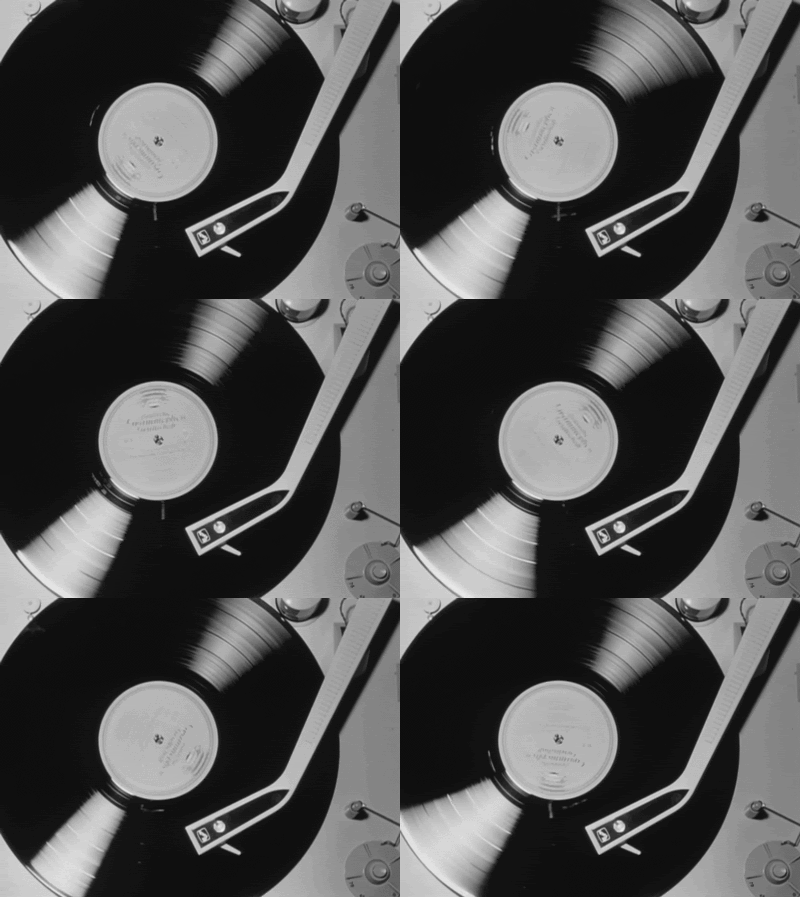
RECORD LABEL
A record label, derived from the circular label in the centre of a vinyl record, refers to a company that owns the record as they produce, distribute, and market the music they own. These labels invest their capital in signing record deals with artists, giving labels the right of ownership to the music they produce. Artists benefit from such deals as it allows them access to better production equipment, collaborations with professionals in the music industry and bigger budgets to execute their artistic visions. These labels also offer legal support to artists, protecting them from copyright infringement and offering networking and partnership opportunities with major companies and artists. An artist may be signed with multiple labels at a time to help distribute globally, and in regions a label does not distribute at. In return, labels get their share of the profit from royalties on selling merch, records, tour tickets, etc. In an ideal world, this would be perfect, but to some extent, the artists have to relinquish ownership, control and their creative freedom to please the company they are signed with.
This control extends over artists' star image as record labels have specific marketing and PR teams to craft a narrative around the artists to make them more marketable and attractive to the audience. This can be done through Publicity stunts of fake relationships between artists to generate interest in both artists' work, press conferences, featuring in magazines, giving interviews, etc. Universal Music Group, Sony Music Entertainment, and Warner Music Group are categorised as the "Big Three", the three major record labels dominating the industry. Interscope record label (owned by UMG), with Olivia Rodrigo under their wing, has sold her music but also made her into a star, with her songs featuring everywhere from film and television to herself featuring in covers of iconic magazines, i.e. Teen Vogue and Time and advertisements. These deals have helped sell albums over 17.4 million and kept the artist relevant till her next album release.


Preliminary survey form: Creation
ZAHRA ASLAAM
Preliminary survey form: Response
ZAHRA ASLAAM
Genre Selection: Pretending I know much about music

Selecting a genre required us to find the genre of interest that overlapped for each of us, which was done by slowly getting the ball rolling in WhatsApp discussions by sending in music suggestions until we listened to songs for hours. Thus, we decided to cut down our list using elimination. Presenting to you below is an amalgamation of our music taste.
Through the playlist, a trend began to emerge as most of the songs we had added were from indie folk or indie pop artists. Thus, we have chosen the Alt/Indie genre that features both types of artists.
What is Alt/Indie music?
By definition, Indie music originated from independent musicians without a major record label backing them, leaving them only with hope and a will to make it into the industry with a do-it-yourself approach to music, which has now become an ethos of the genre. With the rapid proliferation of technology, everyone is equipped with a laptop, allowing them access to the technology, however mediocre it may be, to start producing original music. This liberation from record labels allows them to create art without the constraints of filtering their music to appeal to a record label to get their big break into the industry; instead, it is now possible to share their raw version of music with the listeners via the internet. Thus, Indie music has emerged as an opposition to the commercialisation and homogenisation of mainstream music.
Some indie artist may also be signed with independent record labels, allowing them a little more budget for their production. By independent record labels, I mean labels not affiliated with the big three record labels controlling 90% of the music industry. Over time, indie has become an umbrella term that hosts multiple genres, as the creativity of independent music artists makes it quite hard to categorise. Alternatively, alternative music is the term used for experimental music that cannot be categorised into the conventional pop, rock, R&B genres, etc.
Codes and conventions of Alt/Indie genre
ZAHRA ASLAAM
Instruments used in genre
Noor Ul Emaan
Artists in the genre (that I like)
Indie music has a lot of underground artists, along with the ones who have had their big break into the music industry. In this post, I have explored various artists in the alt/indie musicscape whose work I adore to gain insight into the type of artist we would like to create for our Music Video for our digipack.
Phoebe Bridgers
Phoebe Bridgers is an American singer-songwriter who made her name in the indie scene through her debut album, Stranger in the Alps, released in 2021, which earned her critical acclaim. Through the years, she has gained widespread recognition for her indie rock and indie Folk music. She is also part of an indie group, Boygenius (2018-now) which helped her launch her career as an indie musician.


Noah Kahan
Noah Kahan's breakthrough single, "Hurt Somebody", received a golden status in the US and charted in multiple international markets. However, the song that is most beloved by his audience is Stick Season, which started going viral amongst the crowds he performed at even before the song was released. With its release in 2020, Kahan shifted his music genre from pop to indie folk seeing the connection he felt through singing such songs to the audiance.
Madilyn Mei
Madilyn is an indie folk artist from Arizona whose songs feature folk-esque nostalgic tunes. She has come a long way from booking local gigs to reaching 1 M+ streams this year by gaining recognition through her social media as she used to post ukele songs on YouTube and now she has over 225K followers on Instagram.


Wasia Project
The British-East Asian sibling duo, William Gao (Heatstopper actor) and his sister Olivia Hardy, managed to merge classical, jazz and indie pop into their debut album "How Can I Pretend", which they like to label an "Alternative mess". With only one EP and eight singles, wasia project has over 1.5 million monthly Spotify listeners.
Alt/Indie MV
Music videos in the alt/indie genre conform to the genre's conventions yet still bring something new to the table, as these MVs allow the artists to represent themselves as labels and set the tone for the album. Below, I will review some of my favourite videos in the genre.
The MV for 'Looking U Up' was directed and produced by Zach Tavel to follow the codes and conventions of dreamy aesthetics as theorised by John Stewart. It featured exaggerated makeup as the artist is covered in a clown look as the presumably text and ex. It uses dramatic zoom-ins and outs and stylistically low resolution to make it look nostalgic. in the simplest terms, the music video parallels the lyrics and shows two girls trying to get over texting their exes.
Stick Season MV is a performance featuring Kahan lip-syncing to his song in the car. This car footage is disrupted by him standing in front of a certain location, showing him driving up to Vermont, which reminds him of a person he was in a relationship with. All these locations remind him of the person, as can be interpreted by the song along with the visuals. The Music video does not seem to have much deeper meaning as it is a slight twist on a simple performance.
The interpretive music video of Scott Street by Pheobe Bridgers depicts various aspects of our lives, such as graduation, marriage, going to the arcade with friends, celebrating a birthday party, etc. Toward the end of the music video, it also touches upon a feeling of isolation as her friends celebrate, and she looks directly at the camera and sings the song to us.
The narrative-driven music video for Sleep on the Floor employs Syd Field's Narrative Theory. It captures a woman at her father's funeral. This situation is the 'Act 1: Setup'; she leaves everything behind to get out of her small town with her boyfriend and instead starts to live day by day, enjoying life outside, which is the "Act 2" midpoint". In the end, there is a turn of events as everything turns out to be her imagination of what could have been if she had listened to her boyfriend which is the "Act 3: Climax"; instead, she faints to the ground with all her dreams unfulfilled. It has amassed a total of 214 million views on YouTube.
'Petals on the floor'-Wasia project music video is a low-budget MV featuring the artists roaming around New York and just goofing around each other. This music video thus employs Goodwin's star image theory as the artist has chosen to define their image as quirky and fun through the MV. Once again, the camcorder footage creates a nostalgic effect.
Essentially, the codes and conventions they follow bind all these music videos under one roof. Locations used for the music videos are primarily limited due to the low budget; thus, we see little shift in location as they range from 3 to 6 locations on average. Music videos that are more static and focus on the individual tend to employ more exaggerated costumes, such as in ‘Scott Street’ and ‘Looking You Up,’ i.e., with the use of wigs and clown makeup. The footage is emulated to look like film, giving a soft, blurry look, and is synced to the beats in each music video; however, the pacing of the cuts is slow, and we get to enjoy the music video, unlike pop music videos that are extremely quick paced.
